


Views: 793 Author: Site Editor Publish Time: 2025-10-14 Origin: Site


For brands, teams or individuals looking to create a head-turner, the custom baseball cap delivers style, function and personality in one neat package. But what exactly happens between the first spark of an idea and the moment the finished cap lands on your head? Below is a step-by-step roadmap that walks you through the entire journey—from napkin sketch to wear-ready product.
1. Pre-Production Prep: Lock in the Basics
Getting these details straight before any fabric is cut will save time, money and headaches later.
1.1 Choose the Silhouette
• 6-panel classic – the everyday workhorse; follows the curve of most heads and gives a clean billboard for logos.
• 5-panel – streetwear favourite; fewer seams = one uninterrupted front panel for bold graphics.
• Trucker – foam front (great for 3-D puff embroidery) + mesh back = maximum airflow for outdoor gigs.
Match the shape to the mission: sports squads usually want the rugged 6-panel; fashion labels after a minimalist vibe pick the 5-panel.
1.2 Pick the Fabric
• Cotton twill – soft, breathable, prints crisply; watch for slight shrinkage in hot washes.
• Polyester – colour-fast, wrinkle-shy and quick-dry; ideal for race-day giveaways or fishing charters.
• Wool blend – luxe hand-feel and winter-ready structure; skip it for humid climates.
• Mesh (trucker backs) – feather-weight moisture management.
1.3 Select the Closure
• Snap-back – plastic snaps, street cred included.
• Hook-and-loop – soft edge, kid-safe and fast on/off.
• Metal or delrin slide buckle – bomber-tough for work crews and ball teams.
2. Design Lock-In: Make It Makeable
A great file on screen means nothing if it can’t survive a sewing machine. Design for production.
2.1 Create & Optimise Artwork
• Size & Placement – the front panel sweet spot is 3.5–4 in (9–10 cm) wide. Keep letters ≥ 0.25 in (6 mm) tall or they’ll stitch like Braille.
• Colour – spec PMS chips (e.g., PMS 485 red) so the ink or thread mixer hits your brand hue dead-on.
• Mock-ups – demand a digital proof, then a physical pre-production sample. Check for arc distortion: circles can turn into eggs once they’re pulled over a curved crown.
2.2 Choose the Decoration Method
• Embroidery – raised, rugged, forever. 3-D puff shouts; flat stitch whispers.
• Screen-print – big, colourful, budget-friendly on smooth fabrics; skip it on fuzzy wool.
• Heat-transfer – photo-real gradients possible; expect shorter wash life than thread.
• Patch – sew-on or iron-on woven/emb badges for retro or limited-drop flavour.
3. Sampling & Approval
Once the factory digitises your art (embroidery) or outputs films (print), they’ll make a single prototype. Wear it, sweat in it, cram it in a backpack—then sign off. Changes after bulk cloth is cut get expensive fast.
4. Bulk Production
Typical MOQ (minimum order quantity) is 50–100 pcs. Lead time: 10–25 days plus shipping, depending on complexity. Insist on mid-production photos so you can catch a thread-break or colour shift before 5 000 hats are done wrong.
5. Finishing & Shipping
Hats are steamed, de-linted, shaped on aluminium blocks and flat-packed in 50 pc cartons. Ask for individual poly-bags if you’re selling retail. Door-to-door air courier adds ~5–7 days; sea freight saves cash but plan on a month.
Pro Tips for a Pain-Free Run
• Send vector files (.AI, .EPS) with fonts converted to outlines.
• If you need exact Pantone matches on both fabric and thread, order fabric swatches first—dye lots shift.
• For one-off gifts or micro-runs, explore on-demand embroidery platforms; per-unit cost is higher but there’s no MOQ.
• Think ahead to packaging: custom woven labels, internal taping or even a hidden pocket turn a giveaway cap into a keepsake.
From sketch to shipment, every decision—seam height, thread weight, closure colour—adds up to a cap that either screams “cheap promo” or becomes the one people reach for every Saturday. Control the process and your hat won’t just sit on heads; it’ll start conversations.
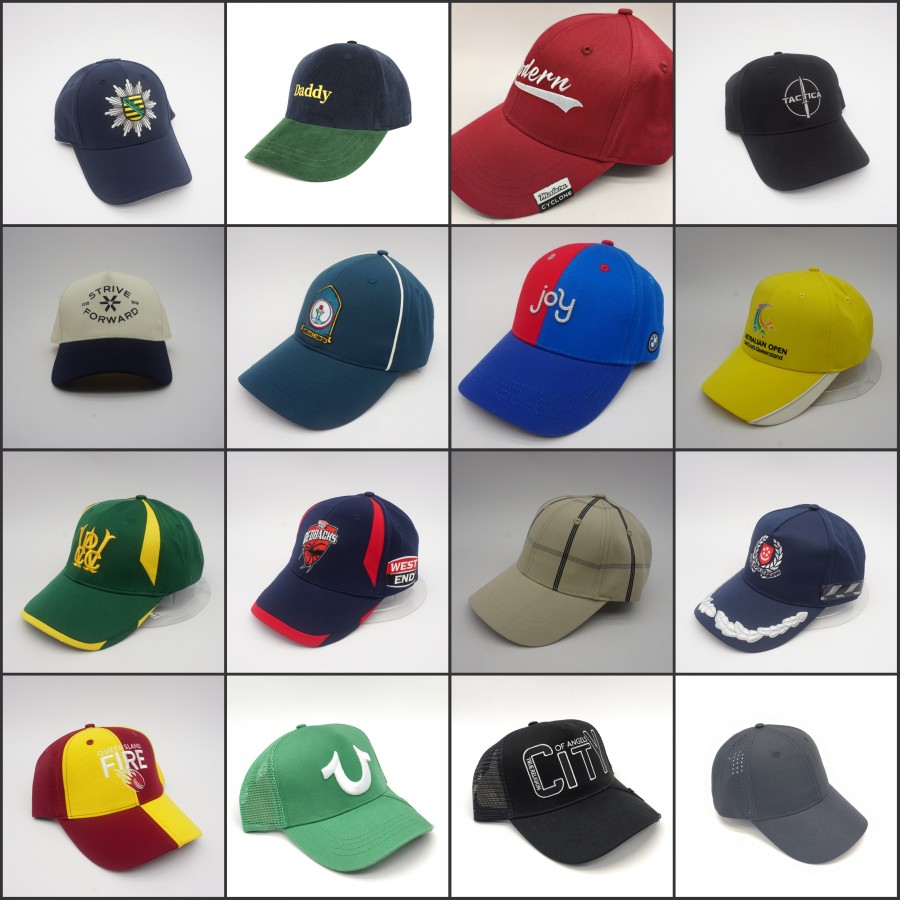
3. Production and production: from fabric cutting to hat assembly
After the design and material are determined, the production process officially begins - usually carried out by a professional hat decoration factory.
(1) Fabric cutting
The factory first uses a computer numerical control cutting machine to cut the fabric into corresponding quantities of hat pieces according to the size of the hat (such as adult and children's styles) (6 pieces for a classic six piece hat and 5 pieces for a five piece hat). This method ensures that the shape and size of each cap piece are completely consistent, which is the key to ensuring the regularity of the finished product.
(2) Decorative processing (embroidery/printing)
The decoration process needs to be completed before assembly (flat hat pieces are easier to operate than sewn hats):
Embroidery process: The factory inputs the design pattern into the embroidery machine programming, and then uses a "fixed frame" to tighten the front fabric to prevent misalignment before proceeding with the embroidery operation.
Screen printing process: The design pattern is layered by color, with each layer corresponding to a piece of screen. It is printed on the cap plate in sequence, and finally the ink is dried at high temperature to fix the color.
(3) Hat piece sewing and hat top forming
Sewing workers (or automated sewing machines) stitch the cut hat pieces together to form the "top" of the hat (the part covering the head). For a six piece hat, all hat pieces will be sewn onto the central "top buckle" - the top buckle not only hides the seams but also enhances the delicacy of the finished product.
(4) Install brim and adjustable buckle
• Hat brim production: The brim (also known as the "brim") is made of hard materials (such as plastic, cardboard) wrapped in fabric, cut into corresponding shapes, folded, and sewn to the top and bottom of the hat. Some hats will choose between "curved brim" (classic style) or "flat brim" (street style) according to their style, which has been determined during the production stage.
Adjustment buckle installation: Fix the buckle, Velcro or snap on adjustment buckle on the back of the cap by sewing or riveting. This stage will undergo quality inspection to ensure that the adjustment buckle is securely installed and smoothly adjusted.
4、 Quality inspection and final delivery
Before leaving the factory, each hat must undergo strict testing to ensure compliance with quality standards
• Appearance inspection: Check for loose thread ends, misplaced embroidery, color deviation, and other issues.
• Size adaptation testing: Test the adjustment buckle function to ensure it can adapt to different head circumferences (adult hats usually adapt to 21-24 inch head circumferences).
• Water washing test (sampling): Take a small sample for water washing to check for fading, shrinkage, or pattern peeling - this is particularly important for hats that need to be worn daily.
After passing the inspection, the hat will be packaged (usually individually bagged to prevent damage during transportation) and shipped. For bulk orders, manufacturers can also provide customized packaging (such as brand exclusive gift boxes) to enhance the unboxing experience.
Why choose a professional custom hat accessory manufacturer?
Although there are DIY customization methods, professional manufacturers (such as those specializing in hat accessory production) have professional equipment, mature technology, and strict quality control systems, which can effectively avoid common problems such as embroidery misalignment, adjustment buckle discomfort, and mismatch between fabric and brand requirements. In addition, they can provide material selection suggestions, design optimization solutions, and even assist in compliance certification (such as selecting OEKO-TEX) ® Certified fabrics that meet the needs of environmentally friendly brands.
Whether you are customizing hats for sports teams, brand promotion, or creating personal exclusive styles, understanding the customization process can help you make wiser decisions and ultimately achieve high-quality products that satisfy yourself.
Although there are DIY customization methods, professional manufacturers (such as those specializing in hat accessory production) have professional equipment, mature technology, and strict quality control systems, which can effectively avoid common problems such as embroidery misalignment, adjustment buckle discomfort, and mismatch between fabric and brand requirements. In addition, they can provide material selection suggestions, design optimization solutions, and even assist in compliance certification (such as selecting OEKO-TEX) ® Certified fabrics that meet the needs of environmentally friendly brands.
Whether you are customizing hats for sports teams, brand promotion, or creating personal exclusive styles, understanding the customization process can help you make wiser decisions and ultimately achieve high-quality products that satisfy yourself.


